



From antiquity, practically until the end of the 16th century, money was produced by manual minting, that is, using a striking technique in which each individual piece was created separately. The process required precise preparation, coordination among multiple people, and a high degree of craftsmanship. Minting took place through clearly defined phases.
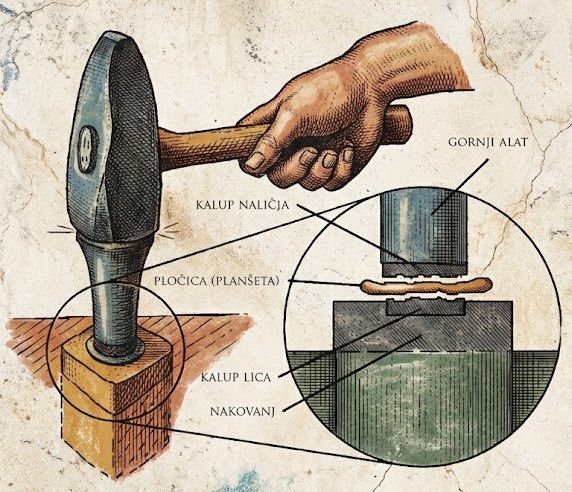
1. Preparation of the metal base. The first step was the creation tiles, i.e., a small, approximately round piece of metal. Gold, silver, or bronze was used as raw material, depending on the type and denomination of the coin. The mass of the flan was predetermined and strictly controlled. Immediately before striking, the flans were often heated to soften the metal and allow it to more easily receive the impression of the die.
2. Preparation of the workplace. A massive one served as the foundation anvil, often fixed in a wooden or stone block. The stability of the anvil was crucial for the quality of the forgings and work safety.
3. Placing the face mold. U anvil It was firmly fixed facial mold, the lower die with the engraved negative of the obverse of the coin. In the Roman period, the obverse most frequently featured a portrait of the emperor, along with the corresponding inscription. The dies were made of hard metal and engraved by experienced masters or their assistants.
4. Adjusting the plank (platform). Warmed up tablet was placed on facial mold Using special pliers or gripping tools, the anvil had to be properly positioned and centered to ensure a good strike. Any movement at this stage could result in a misaligned or partial strike.
5. Placing the back mold. It was placed on the tablet from above backside mold, which bore the negative motif of the reverse side of the coin. The reverse side often depicted deities, personifications, symbols of victory, or architectural motifs. The reverse die was an integral part of of the top tool, which held itself vertically above the workbench.
6. Positioning the upper tool. The upper tool He carefully pressed it against the planks, which placed the piece of heated metal exactly between them. Face mold i case of the back side.Proper centering was crucial to the aesthetic and technical quality of the coin.
7. Impact force and the forging act. The final and most important step was a powerful blow with a heavy hammer on top. of the top tool.The impact energy simultaneously impressed the motifs from both molds into the metal:
- facial mold It left a mark on the underside of the plank.
- backside mold he was leaving a mark on the upper side
Under ideal conditions, one powerful strike was enough, although sometimes two were needed.
8. Removal of the mold and extraction of the money. After the impact backside mold was removed. The minted money was taken from Face mold, often using tongs. Failed or poorly forged pieces could be re-forged or set aside for remelting.
9. Cooling and control. The finished coins were left to cool. The weight, legibility of the inscriptions, and overall quality of the relief were checked. Only flawless specimens were released into circulation.

In Roman mints (Lat. workshop) Forging was a team effort. As a rule, three people participated in the forging process:
- support – he placed the tablet on the face mold
- malleator He was hammering the top tool.
- signatory – the worker responsible for holding the upper part of the tool, and according to some sources, the master craftsman responsible for control and the overall quality of the forging.
He was in charge of making the molds and engraving them. sculptor.
Due to manual forging, every single coin was unique. During minting, irregularities such as shifted strikes, uneven thickness, and irregular edges were frequent. Likewise, each die could withstand only a small number of strikes before cracking or breaking. Therefore, it was necessary to produce a larger number of dies for the same coin type, and due to manual production, they were not completely identical.
Precisely these characteristics and the aforementioned forging technology have led to a large number of different coin specimens and their variants, which ultimately enriches numismatics.
Author: Zlatko Viščević
Photos: Numex – Coins, Banknotes & Militaria Store [www.numex.hr]