
Following the end of the Second World War and prior to the signing of the peace treaty with Italy, Zone “B” – which encompassed Rijeka, part of Istria, and the Slovenian Littoral – was placed under the administrative control of the Military Administration of the Yugoslav Army (VUJA). In accordance with the international rights pertaining to occupying authorities, VUJA decided to issue its own currency for the territory of Zone “B” in order to ensure the functioning of the economy and the payment of the administrative apparatus.
In the period immediately following the war, the only means of payment in Rijeka and the rest of Zone “B” were the metropolitan lire issued by the Banca d’Italia. However, many Italian companies withdrew their cash from that area toward Zone “A” or back to Italy, which caused a serious monetary crisis. The VUJA then faced extremely difficult circumstances: the port of Rijeka and industrial facilities were heavily damaged, while numerous Istrian villages were devastated by war destruction.
In Zone “A”, the British authorities exercised their rights and introduced AMG lire as an occupation currency. Consequently, VUJA also issued its own money, officially called “B lire”. Among the people, these banknotes were called various names: “Tito's lire”, “barchette lire”, and most commonly simply – “Jugolire”. Although formally classified as occupation money, the Jugolira holds special significance because it was the first money in the Istrian region printed in the national language, which gives it a strong national character.
During that period, the Yugoslav dinar (the dinar of the Democratic Federal Yugoslavia – DFJ) could not be introduced as legal tender, since the laws of Yugoslavia had no legal force in Zone “B”, and the National Bank of Yugoslavia had no jurisdiction over that area. For this reason, the Provincial National Liberation Committee (NOO) for the Slovenian Littoral, the Regional NOO for Istria, and the City NOO of Rijeka, with the approval of VUJA, made the decision to establish a special financial institution – the Economic Bank for Istria, Rijeka, and the Slovenian Littoral, headquartered in Rijeka.
The Economic Bank was officially founded on September 17, 1945, with an initial capital of 100 million lire.
As early as September 18, 1945, the Military Administration of the Yugoslav Army (VUJA) issued an order on putting a new currency into circulation, which reads:
ORDER No. 26
Military Administration of the Yugoslav Army for the Julian March, Istria, Rijeka, and the Slovene Littoral.
Lately, it has been observed that there is not enough money in circulation in the territory of this Military Administration of the Yugoslav Army. Such a situation could have certain consequences regarding the needs of the economy and the people in general. To improve the situation and enable the smooth further development in the field of reconstruction and the economy, and to improve the monetary situation, and related to that, the living conditions of the people in this territory, that the Economic Bank for Istria, Rijeka, and the Slovene Littoral put into circulation new lira banknotes of 1, 5, 10, 20, 50, 100, 500, and 1,000 liras.
The value of the new lira banknotes is equal to the value of the old ones (Banco d'Italia). The old banknotes (Banco d'Italia) remain in circulation.
The exchange rate of the new lira banknotes against the dinar is equal to the rate of the old ones, i.e., 3.33 : 1.
A description of the new banknotes will be published later in the daily press. From the date this Order comes into force in the territory of this Military Administration J. A. (Istria, Rijeka, Slovenian Littoral), the new lira banknotes in denominations of 1, 5, 10, 20, 50, 100, 500, and 1,000 lire shall be legal tender.
This order takes effect immediately.
Death to fascism – Freedom to the people!
Opatija, January 18, 1945.
Colonel: V. Holjevac, m. p.
Behind this post, the description of the “B” lira was published in the daily press. The lire looked like this:
1 lira
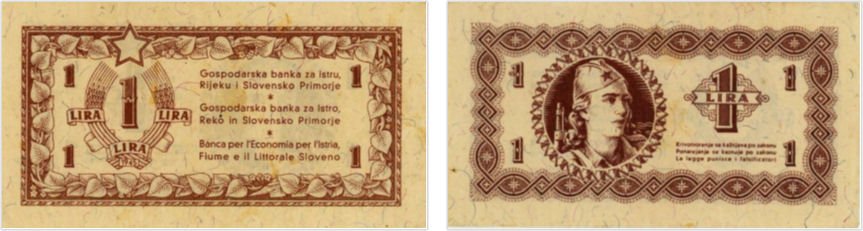
Dimensions: 91 x 49 mm
Obverse: In the left part, within the ear of grain, is the number 1, and above it is a five-pointed star. The ribbon reads „LIRA“ three times and „1945“. On the right is an inscription in three languages: „Gospodarska banka za Istru, Rijeku i Slovensko Primorje“ / „Gospodarska banka za Istro, Reko in Slovensko Primorje“ / „Banca per l’Economia per l’Istria fiume e il Litorale Sloveno“. In all four corners is the number 1. Surrounding everything is a border of linden leaves.
Reverse: In the left part is the figure of a female partisan facing right. On the right is the denomination mark „1 LIRA“. Below that is an inscription in three languages: „Krivotvorenje se kažnjava po zakonu“ / „Ponajeranje se kaznuje po zakonu“ / „La lege punisce i falsificatori“. Around everything is a border of geometric ornaments.
5 lira
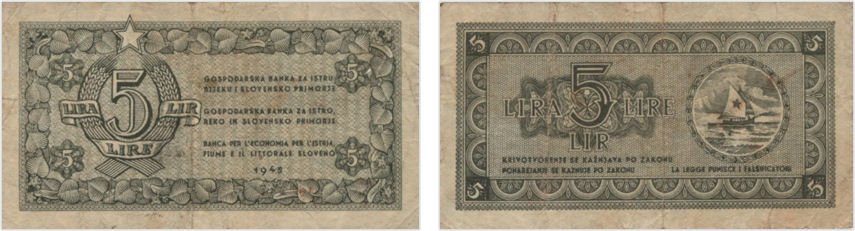
Dimensions: 98 x 50 mm
Face: On the left part of the ear of grain is the number 5, and above it is a five-pointed star. The ribbon reads „LIRA“ – „LIR“ / „LIRE“. On the right is the inscription in three languages: „GOSPODARSKA BANKA ZA ISTRU, RIJEKU I SLOVENSKO PRIMORJE“ / „GOSPODARSKA BANKA ZA ISTRO, REKO IN SLOVENSKO PRIMORJE“ / „BANCA PER L’ECONOMIA PER L’ISTRIA FIUME E IL LITORALE SLOVENO“ and the year „1945“. In all four corners is the number 5. Surrounding everything is a border of linden leaves.
Reverse: In the right part is the depiction of a vessel (boat) with a star on the sail. On the left is the denomination designation „LIRA 5 LIRE / LIR“. Below that is the inscription in three languages: „KRIVOTVORENJE SE KAŽNJAVA PO ZAKONU“ / „PONAJERANJE SE KAZNUJE PO ZAKONU“ – „LA LEGE PUNISCE I FALSIFICATORI“. Surrounding everything is a border of geometric ornaments. In each corner of the border is the number 5.
10 liras
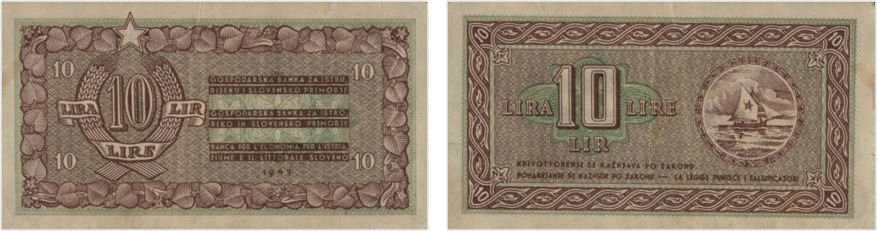
Dimensions: 100 x 55 mm
Obverse: On the left part, in the ear of grain, is the number 10, and above it is a five-pointed star. The ribbon reads „LIRA“ – „LIR“ / „LIRE“. On the right is the inscription in three languages: „GOSPODARSKA BANKA ZA ISTRU, RIJEKU I SLOVENSKO PRIMORJE“ / „GOSPODARSKA BANKA ZA ISTRO, REKO IN SLOVENSKO PRIMORJE“ / „BANCA PER L’ECONOMIA PER L’ISTRIA FIUME E IL LITORALE SLOVENO“ and the year „1945“. In all four corners is the number 10. Around everything is a border of linden leaves.
Reverse: On the right side is the depiction of a vessel (boat) with a star on the sail. On the left is the denomination designation „LIRA 10 LIRE / LIR“. Below that is the inscription in three languages: „KRIVOTVORENJE SE KAŽNJAVA PO ZAKONU“ / „PONAJERANJE SE KAZNUJE PO ZAKONU“ – „LA LEGE PUNISCE I FALSIFICATORI“. Around everything is a border of interlaced ornaments. In each corner of the border is the number 10.
20 liras
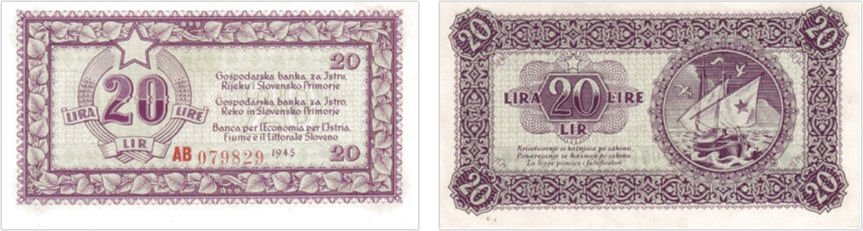
Dimensions: 106 x 75 mm
Face: In the left part of the ear of grain is the number 20, and above it is a five-pointed star. The ribbon reads „LIRA“ – „LIRE“ / „LIRE“. To the right is the inscription in three languages: „Gospodarska banka za Istru, Rijeku i Slovensko Primorje“ / „Gospodarska banka za Istro, Reko in Slovensko Primorje“ / „Banca per l’Economia per l’Istria fiume e il Litorale Sloveno“ and the year „1945“. In both right corners is the number 20. Around everything is a border of linden leaves.
Reverse: In the right part is the depiction of a vessel (boat) with a star on the sail. On the left is the denomination designation „LIRA 20 LIRE / LIR“. Below that is the inscription in three languages: „Krivotvorenje se kažnjava po zakonu“ / „Ponajeranje se kaznuje po zakonu“ / „La lege punisce i falsificatori“. Around everything is a frame of ornaments. In each corner of the frame is the number 20.
50 lira
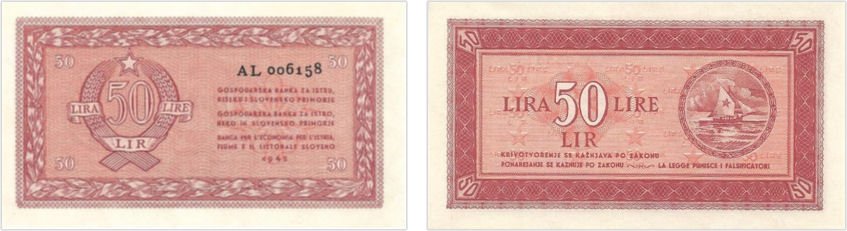
Dimensions: 116 x 64 mm
Obverse: In the left part, in a sheaf, is the number 50, and above it is a five-pointed star. On the ribbon is written "LIRA" – "LIRE" / "LIR". On the right is an inscription in three languages: "GOSPODARSKA BANKA ZA ISTRU, RIJEKU I SLOVENSKO PRIMORJE" / "GOSPODARSKA BANKA ZA ISTRO, REKO IN SLOVENSKO PRIMORJE" / "BANCA PER L'ECONOMIA PER L'ISTRIA FIUME E IL LITORALE SLOVENO" and the year "1945." In each of the four corners is the number 50. A wreath of leaves surrounds the entire design.
Reverse: On the right side is a depiction of a vessel (boat) with a star on the sail. On the left is the denomination designation „LIRA 50 LIRE / LIR“. Below that is an inscription in three languages: „KRIVOTVORENJE SE KAŽNJAVA PO ZAKONU“ / „PONAJERANJE SE KAZNUJE PO ZAKONU“ – „LA LEGE PUNISCE I FALSIFICATORI“. Surrounding everything is an ornamental border. In each corner of the border is the number 50.
100 liras
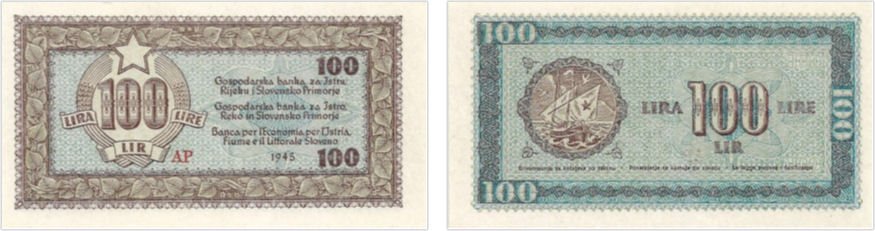
Dimensions: 130 x 70 mm
Obverse: In the left part, within the ear of grain, is the number 20, and above it is a five-pointed star. The ribbon reads „LIRA“ - „LIRE“ / „LIR“. On the right is the inscription in three languages: „Gospodarska banka za Istru, Rijeku i Slovensko Primorje“ / „Gospodarska banka za Istro, Reko in Slovensko Primorje“ / „Banca per l’Economia per l’Istria fiume e il Litorale Sloveno“ and the year „1945“. In both right corners is the number 100. Surrounding everything is a border of linden leaves.
Reverse: In the left part, there is an image of a vessel (boat) with a star on the sail. On the right is the denomination marking „LIRA 100 LIRE / LIR“. Below that is an inscription in three languages: „Krivotvorenje se kažnjava po zakonu“ – „Ponajeranje se kaznuje po zakonu“ – „La lege punisce i falsificatori“. Surrounding everything is an ornamental border. In the left corners of the border is the number 100, and in the middle of the right border.
500 liras
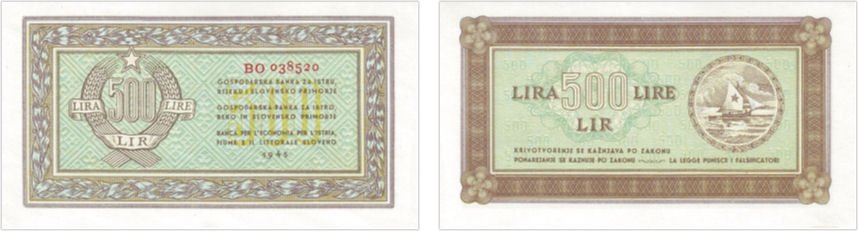
Dimensions: 134 x 75 mm
Obverse: In the left part, in a sheaf, is the number 500, and above it is a five-pointed star. On the ribbon is written "LIRA" – "LIRE" / "LIR". On the right is an inscription in three languages: "GOSPODARSKA BANKA ZA ISTRU, RIJEKA AND THE SLOVENIAN LITTORAL" / "GOSPODARSKA BANKA ZA ISTRO, REKO IN SLOVENSKO PRIMORJE" / "BANCA PER L'ECONOMIA PER L'ISTRIA FIUME E IL LITORALE SLOVENO" and the year "1945." The whole is surrounded by a wreath of leaves.
Reverse: On the right side is a depiction of a vessel (boat) with a star on the sail. On the left is the denomination designation „LIRA 500 LIRE / LIR“. Below that is the inscription in three languages: „KRIVOTVORENJE SE KAŽNJAVA PO ZAKONU“ / „PONAJERANJE SE KAZNUJE PO ZAKONU“ – „LA LEGE PUNISCE I FALSIFICATORI“. Around everything is a border of ornaments.
1,000 liras
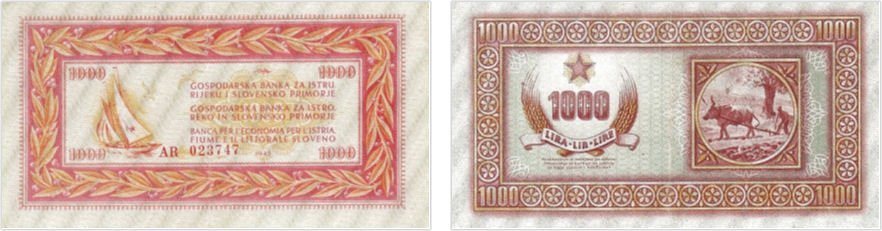
Dimensions: 146 x 79 mm
Obverse: On the left is a depiction of a vessel (bark) with a star on the sail. On the right is an inscription in three languages: „GOSPODARSKA BANKA ZA ISTRU, RIJEKU I SLOVENSKO PRIMORJE“ / „GOSPODARSKA BANKA ZA ISTRO, REKO IN SLOVENSKO PRIMORJE“ / „BANCA PER L’ECONOMIA PER L’ISTRIA FIUME E IL LITORALE SLOVENO“ and the year „1945“. In all four corners is the number 1000. Around everything is a border of leaves.
Reverse: On the right side is a depiction of an ox and a plowman. On the left side in the ears of wheat is the number 1000, and above is a five-pointed star. On the ribbon reads „LIRA – LIR – LIRE“. Below that is an inscription in three languages: „Counterfeiting is punishable by law“ / „Counterfeiting is punishable by law“ / „The law punishes counterfeiters“. Around everything is a border with little flowers. In each corner of the border is the number 1000.
According to the minutes of the Economic Bank of October 17, 1945 (p. 32), a total of only one billion lire was issued. As early as October 24 of the same year, “B” series lira banknotes in the value of 248,820,000 lire were in circulation (Minutes of the Economic Bank, p. 39, art. 2). The banknotes were printed in Ljubljana and Zagreb. It follows from the same minutes that the Commission for Printing Banknotes delivered 100,000,000 lire from Ljubljana and 197,370,000 lire from Zagreb (Minutes of the Economic Bank, p. 39, art. 3).
The “B” lira, issued for use in Zone B, did not have the character of an inflationary currency and was not put into circulation as a substitute for existing money, but rather with the aim of curbing speculation and addressing financial challenges. As an occupation currency, the “B” lira was put into circulation in accordance with the quota provided for by the financial policy for that territorial zone.
Immediately after being put into circulation, the Italian authorities tried to undermine confidence in the new issue. Despite this, practice showed that the “B” lira maintained its stability and value until its withdrawal. Trade with Trieste took place through a “clearing” system, while exchange with Yugoslavia was based on import and export licenses issued by the Economic Department of the Military Administration of the Yugoslav Army. All payments for goods exported from Yugoslavia, as well as the collection of claims for goods exported to Yugoslavia, were carried out exclusively through aggregate accounts in lire, opened at the Economic Bank in Rijeka and its branch in Postojna. The value of goods exported from Zone B to Yugoslavia, calculated through these aggregate accounts, was determined at the exchange rate of 30 dinars for 100 lire.
Out of respect for international law, the Military Administration of the Yugoslav Army issued a strict ban on the use of the dinar as a means of payment in that zone.
Rijeka thus belonged to the lira currency zone, while Sušak was in the dinar zone of the Democratic Federal Yugoslavia (DFY).
However, immediately after the conclusion of the peace treaty with Italy, it was necessary to eliminate this absurd situation in economic operations – one city, and two currencies!
Additionally, due to the strengthening of economic activity in Zone “B”, there was an increased circulation of money, which led to a significant reduction in the reserves of Zone “B” lira banknotes at the Economic Bank.
For the stated reasons, an urgent need arose to annex the foreign exchange area of Rijeka to Yugoslavia, which would resolve two key problems. First, it would eliminate the anomaly of having one currency valid in one part of the city and another in the other, while clearly establishing the border between the Dinar and Lira foreign exchange areas along the line between Rijeka and Opatija. Second, this would avoid the need to print additional banknotes for the rest of Zone “B”, since the banknotes withdrawn from Rijeka could cover the needs of Istria and the Slovenian Littoral.
On December 7, 1946, the Ministry of Finance of the FPRY issued a document (Ministry of Finance, Belgrade, Conf. No. 1190, Dec. 7, 1946) to the Supreme Administration for Public Administration (VUJA), approving the proposal to introduce the DFJ Dinar as legal tender in the area of the city of Rijeka, with the obligation of the Economic Bank to withdraw “B” liras from circulation.
The Ministry of Finance forwarded a transcript of the relevant act to the National Bank in Belgrade, along with detailed instructions on the withdrawal of “B” lira banknotes. The document bears the designation of the Ministry of Finance, Belgrade, Conf. VII, no. 1227 of December 13, 1945. It sets forth the following provisions:
The withdrawal and replacement of “B” series lira banknotes in the territory of the city of Rijeka is entrusted to Gospodarska banka in Rijeka;
Removal and replacement must be carried out between Christmas and New Year, within a period not exceeding three days. The replacement is carried out:
a) at the exchange rate of 100 “B” liras for 30 dinars of the Democratic Federal Yugoslavia (DFY);
b) the amount of “B” lira banknotes whose equivalent value does not exceed 5,000 DFJ dinars shall be exchanged in full; for larger amounts, a certificate for the total deposited amount shall be issued;
c) state authorities, companies and social welfare institutions are paid the full amount;
d) The Economic Bank for the ISSP cannot exchange its stock of “B” lira banknotes for DFJ dinars.
After the “B” type lire ceased to be legal tender, the dinar of the Democratic Federal Yugoslavia (DFY) and the metropolitan lira remained in circulation in the city of Rijeka. The latter was calculated at the official exchange rate of 100 metropolitan lire for 15 DFY dinars. Remittances between Zone “B” and Rijeka were handled by the Economic Bank at the rate of 100 “B” lire = 30 DFY dinars, which means that there was no clearing system between Rijeka and Zone “B”.
From a foreign exchange perspective, following the completed exchange, the city of Rijeka was no longer considered a “foreign country.” For the implementation of the conversion of “B” lira in Rijeka, the National Bank appointed Viktor Mataušek, an experienced expert who had previously participated in similar operations in other republics of Yugoslavia. The Ministry of Finance from Belgrade (Conf. No. 108997-1/2 of Dec. 14, 1945) stipulated that the exchange be carried out on December 28, 29, and 30, 1946, so that transactions with the new currency could begin on January 1, 1947.
Due to the importance of the operation and the need to preserve stability, preparations were conducted in strict secrecy. Until the very day of the replacement, December 27, neither the officials of the Economic Bank nor the other employees involved in the process were informed about the entire procedure. Posters and receipts were printed in Zagreb, while the posters in Italian were produced at the last minute in Rijeka. All materials were prepared discreetly, and the announcement of the withdrawal itself came as a surprise to the public.
The Main Exchange Commission consisted of: Lieutenant Colonel Mirko Lenac (President of the VUJA Control Commission), Pavao Mršičić (Head of the VUJA Financial Department), Nikola Radonić (Manager of the National Bank branch in Sušak), Leopold Grbac (Manager of the Economic Bank), and Viktor Mataušek, delegate of the National Bank from Belgrade. A total of eight exchange points were designated, and each was supplied in advance with 2,000,000 dinars.
Following the completion of the conversion, it was established that a total of 325,422,386.57 “B” lire were withdrawn in the Rijeka area, while 93,927,427.50 DFJ dinars were paid out.
Modified and withdrawn liras in the total value of 333,318,969 were used, according to the instructions of VUJA and with the consent of the Ministry of Finance of the FPRY, for the needs of the remainder of Zone “B”. Thus, the circulation of liras was not actually reduced by this withdrawal.
One year after the conversion in Rijeka, the “B” lira, alongside the Metropolitan lira, was a valid means of payment in the territory of Zone “B”. However, based on the notification of the Peace Treaty with Italy, the Presidency of the National Assembly of the FPRY issued a Decree on the Extension of Legal Regulations to the Newly Annexed Territories. Consequently, on September 13, 1947, the Ministry of Finance in Belgrade issued the Decree on the Withdrawal of Lira in the Territory of Zones “A” and “B”. This decree was published in the “Official Gazette” no. 79 of September 16, 1947, and already the following day, September 17, the conversion began in Istria, lasting until September 20 and covering the entire Zone “B”.
The rapid implementation of this measure was made possible thanks to the Commercial Bank, which as early as September 8 provided instructions and all necessary material to the exchange locations in Zones “A” and “B”. The exchange of banknotes denominated in lire was carried out in the centers of the district people's committees, which were responsible for their respective territories.
For the annexed area of Zone “B”, the exchange was carried out in the following towns: Ajdovščina, Tolmin, Idrija, Postojna, Ilirska Bistrica, Opatija, Labin, Vodnjan, Rovinj, Poreč, Pazin, Buzet, and Mali Lošinj. For the area of Zone “A”, the conversion took place in Pula, Sežana, Solkan, Bovec, and Kobarid.
It is important to note that the “B” lira could not be exchanged in Zone “A”. As part of this conversion, all types of lire were completely withdrawn from circulation: Yugoslav lire, Metro lire (issued by “Banco d'Italia”), and AMG lire (issued by the Allied Military Government).
According to the decree on the withdrawal and replacement of banknotes denominated in liras, the official conversion rate for the following issues has been established:
“Lire B”: 100 lira = 30 dinars
“Lire M”: 100 lira = 15 dinars
“Lire AMG”: 100 lira = 15 dinars
The main headquarters of the National Bank in Belgrade, by decision no. Conf. 32367 of October 3, 1947, issued a decision on the cessation of further issuance of “lira B” banknotes. The decision states:
“Starting from the first day of the exchange, the Gospodarska banka can no longer put its banknotes into circulation...”
It was also stipulated that “all branches of the Gospodarska banka shall begin the first day of the exchange with a zero balance in ‘B lira’ banknotes in the vault.”
For the purpose of the exchange, the National Bank has provided the necessary reserves in dinars, namely:
at the branch in Sušak: 700,000,000 dinars
at the headquarters in Ljubljana (for the needs of the subcommittee in Postojna): approximately 300,000,000 dinars
Just like in Rijeka, the exchange in the Istrian region was carried out under the supervision of the main commission for the withdrawal and exchange of banknotes, which operated in zones “A” and “B”.
And this time, inspector Viktor Mataušek was delegated from the Main Headquarters of the National Bank in Belgrade. The Main Commission remained headquartered in Rijeka, while the sub-commission operated in Postojna. According to the dispatch from the Main Headquarters of the National Bank (Belgrade Confidential No. 44898/XI dated September 1, 1947), following the currency conversion carried out in Zones “A” and “B”, the Main Commission performed the final settlement on October 6, 1947. The results showed that the following amounts were withdrawn from circulation and handed over to the National Bank:
B lira: 1,558,080,534
M lira: 556,386,948.20
AMG lira: 18,715,380
For the stated amounts, a total of 553,423,229 dinars of the FPRY was exchanged.
By this currency exchange, the dinar of the FPRY became the sole official legal tender in Istria, whereby that territory, from a foreign exchange perspective, ceased to be considered “foreign” in relation to the rest of Yugoslavia.
As early as October 20, 1947, the National Bank took over the Economic Bank in Rijeka, since it no longer had a valid reason for independent operation.
The “B” lire have a dual meaning. First, they are money on which, for the first time alongside Italian, Croatian and Slovenian were printed with equal status. This is the first national currency in Istria after centuries of dominance by foreign currencies. Although Rijeka already had its paper money partially in the Croatian language as early as 1848, 1849, and 1850 (see: Ivan Rengjeo, “Papirni novac u Hrvatskoj”, Numizmatika, 1953, and Mario Smoquina, “La carta moneta di Fiume negli anni 1848, 1849 i 1850”, Rivista X, 1933), no such case was recorded in the rest of Istria.
The second meaning of the “B” lira is reflected in VUJA's ingenuity in facing the severe post-war monetary crisis. Economic stability and development depended on a strong, reliable currency. The “B” lira maintained a fixed exchange rate of 100 lire to 30 dinars until it was replaced, while AMG and Metrolira had a significantly lower conversion value—100 lire to 15 dinars.
Article edited and adapted by Zlatko Viščević based on the original article “Lire ‘B’, Paper Money Issued by the Economic Bank for Rijeka, Istria, and the Slovenian Littoral in Rijeka, 1945-1947”, by Radmila Matejčić, published in Numizmatičke vijesti, no. 11, 1958, pp. 23-29
Photos: Numex – Coins, Banknotes & Militaria Store [www.numex.hr], Katz Auction [www.katzauction.com], Bank Note Museum [www.banknote.ws], S.R. collection.