





In numismatics, there are numerous records, and one of them is a banknote recorded in the „Guinness World Records,“ which is the banknote with the highest denomination ever issued – 100 trillion pengő (10²⁰). This exceptional, almost surreal banknote denomination was issued in 1946 in Hungary and was in circulation for less than two months, and that under circumstances that to this day remain synonymous with the worst hyperinflation recorded in modern economic history.
Unprecedented hyperinflation
Following the end of World War II, Hungary was economically devastated. War destruction, war reparation obligations, and the complete loss of confidence in the monetary system led to a dramatic collapse in the value of the national currency. Throughout 1945 and 1946, inflation reached enormous proportions and prices, during the most critical periods, doubled every 15 hours.
Under such circumstances, the state was forced to issue banknotes with huge denominations, many of which had negligible purchasing power even at the moment of their release into circulation.
A denomination that transcends reason and its minor value
Banknote in the amount of 100,000,000,000,000,000,000 pengős (this figure has 20 zeros) represents the end point of this inflationary spiral. Despite the astronomical nominal value, its real value was extremely small (around $0.20 USD), which clearly illustrates the scale of the monetary collapse.

Banknote description
The banknote is blue colors, rectangular in format, designed in the characteristic graphic style of late hyperinflation-era pengő issues. The banknote was designed by Ferenc Helbing, and the banknote engraver is Endre Horváth. The dimensions are 159 × 79 mm.
The nominal value itself on the banknote is not indicated by a number, but is stated as „SZÁZMILLIÓ B.-PENGŐ." This „B-pengő” denotes billion pengős (10¹²), so the denomination is expressed as one hundred million trillion pengő.
The issuer of the banknote is the Magyar Nemzeti Bank (Hungarian National Bank).
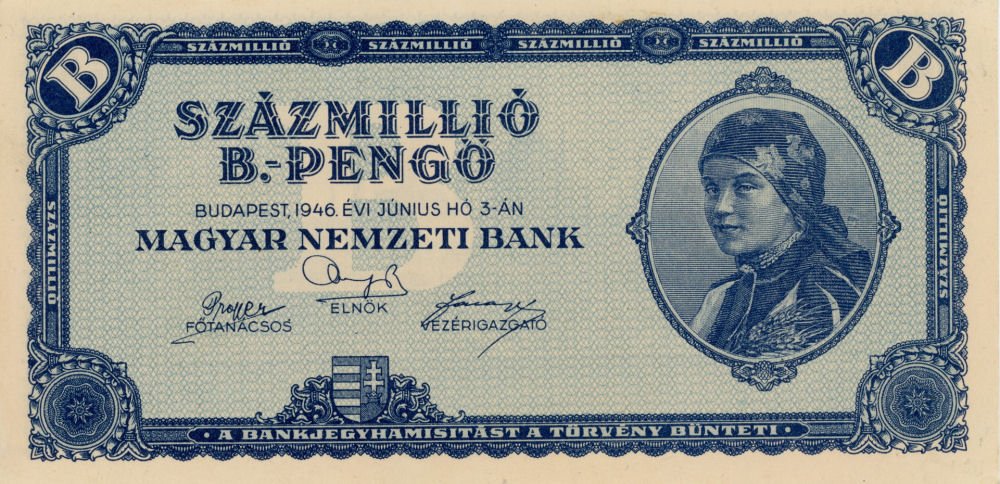
On the right side of the front of the banknote is shown portrait of a young girl with a headscarf, rendered in the classic realistic style common for Hungarian banknotes of that era. In the lower part of the decorative frame is located national coat of arms, while above are the textual elements of the banknote and the signatures of officials of the Magyar Nemzeti Bank.
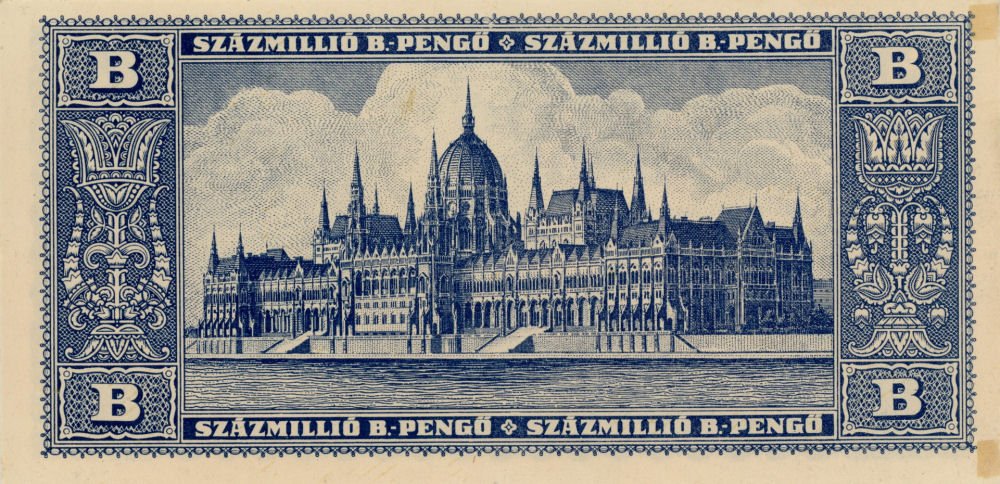
The reverse side of the banknote is dominated by Hungarian Parliament Building in Budapest, shown in a panoramic view. The architectural details are emphasized by fine line engraving, achieving depth and monumentality of the motif. This motif of the parliament is set within an ornamental frame that contains inscriptions in the upper and lower parts.
It is interesting that this banknote has no serial number.
Monetary reform and the abolition of the pengő
In the same year this banknote was introduced, a thorough monetary reform was also carried out. The previous currency, the pengő, was abolished and replaced by a new currency – the forint. The exchange was carried out at a historically extreme rate, thereby ending the most severe episode of hyperinflation ever recorded in a national currency.
The introduction of the forint enabled the stabilization of the monetary system and the gradual return of confidence in money as a medium of exchange and a store of value.
Numismatic value today
Although it was almost worthless at the time of its issue, the 100 trillion pengő banknote today holds considerable numismatic importance, especially if it is well preserved.
Certified, nearly perfectly preserved specimens trade on the market for around 300 EUR, while uncertified ones are somewhat more affordable and range around 200 EUR.
Lower grades of preservation are far more affordable and as such more accessible to a wider circle of numismatists.
A banknote as a witness to an era
The 100 trillion pengő banknote is not just an extreme due to its face value. It represents a powerful testament to the consequences of a complete loss of confidence in the monetary system and the ultimate limits of inflation. Precisely for this reason, it holds a special place in world numismatic history as a warning, but also as a fascinating „artifact“ of one of the most dramatic periods in monetary history.
Author: Zlatko Viščević
Photos: Katz Auction [www.katzauction.com]