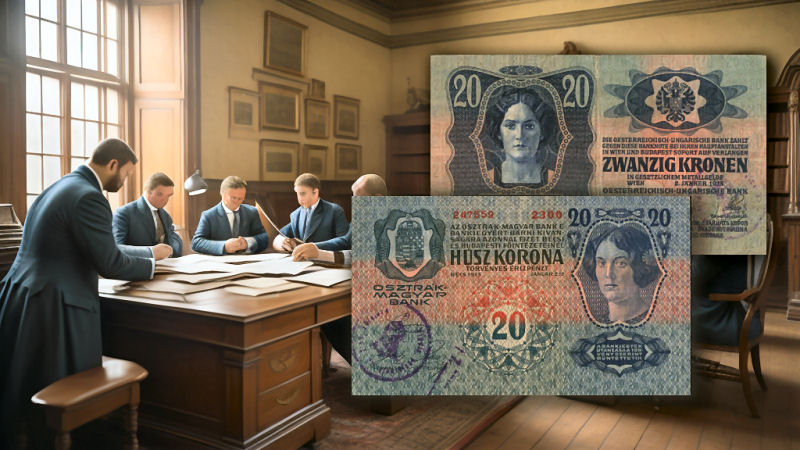
In this article, we provide a basic overview of Austro-Hungarian 1-krone coins that were in circulation from 1892 to 1918. Austro-Hungarian krone coins are part of the national numismatics of all successor states of the former Austria-Hungary, which is why they are quite popular among numismatists and collectors from those countries. They are also popular here, as they were a medium of exchange in Croatia, Slovenia, Bosnia and Herzegovina, part of Serbia (Vojvodina), and present-day Montenegro (Bay of Kotor).
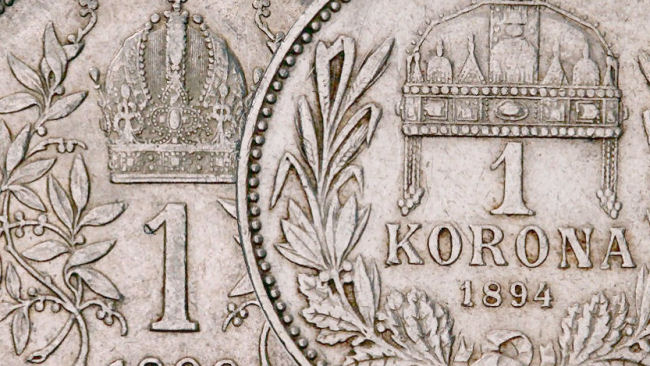
The Austro-Hungarian krone was the basic monetary unit in the Austro-Hungarian monarchy from 1892 until the dissolution of the country in 1918. After that, it continued to be a means of payment for some time in the successor states of Austria-Hungary as well.
The Austro-Hungarian crown was introduced along with the gold standard in 1892 and replaced the previous Austro-Hungarian gulden (florin, forint). During the exchange, 2 crowns were given for 1 gulden.

Austrian part of the monarchy (red); Hungarian part of the monarchy (green); Bosnia and Herzegovina – special status (purple). Image: Wikipedia.
Austria-Hungary was a complex country which, from 1867, consisted of two parts:
- of the Austrian part of the monarchy (the Austrian lands, Cisleithania) and
- of the Hungarian part of the monarchy (Lands of the Crown of Saint Stephen, Transleithania).
This division was also reflected in the currency. As was the case with earlier gulden (florins, forints), two types of crown coins were minted and put into circulation:
- for the Austrian part of the monarchy;
- for the Hungarian part of the monarchy.
Crowns for the Austrian and Hungarian parts of the monarchy
The crowns for the Austrian part of the monarchy contain Austrian national symbols; the inscriptions on them are in Latin, as is the name of the monetary unit: corona, coronae. One crown is divided into 100 hellers.
The crowns for the Hungarian part of the monarchy contain Hungarian national symbols; the inscriptions on them are in Hungarian, as is the name of the currency unit: the corona. One corona is divided into 100 fillers.
Coins of the following denominations have been minted:
1 heller / filler
2 heller / filler
10 heller / filler
20 heller / filler
1 krone
2 crowns
5 korunas
10 crowns
20 kroons
100 krone
The 1 and 2 heller / filler coins were made of bronze. Later, 2 heller / filler coins were minted in iron (during the First World War).
The 10 and 20 heller / filler coins were made of nickel. Later they were struck in a copper-nickel-zinc alloy. The 10 filler and 20 heller / filler coins were also struck in iron (during the First World War).
The 1, 2, and 5 krone coins were made of silver, and the 10, 20, and 100 krone coins were made of gold.
1 Austro-Hungarian krone coins
All 1-krone coins had the same technical characteristics and differed only in their artistic designs and edge inscriptions.
These coins are struck in .835 purity silver; their mass is 5 grams and diameter 23 mm. The thickness of the planchet is 1.50 mm. The edge is plain with an inscription, and they are struck in German (medal) alignment (↑↑).
As already stated, the coins for the Austrian and Hungarian parts of the monarchy differ in their artistic design. Three different types of 1-krone coins were minted for each part of the monarchy: an older and a newer type, as well as a commemorative issue. Thus, in the end, there are as many as six different types of Austro-Hungarian 1-krone coins.
Austrian 1 krone coins
Older type (1892-1907)

Austrian 1 corona, older type, 1892-1907. Picture: Coins, Banknotes & Militaria Store [www.cbm-store.com].
Catalog number according to SCWC (Krause): KM#2804
Lice: Head of Franz Joseph I with a laurel wreath facing right. Around it is a semi-circular inscription: „FRANC·IOS·I·D·G·IMP·AVSTR·REX BOH·GAL·ILL·ETC·ET AP·REX HVNG·“ (abbreviated from: Franz Ioseph I Dei Gratia Imperator Austriae, Rex Bohemiae, Galiciae, Illyriae, etc. et Apostolicam Rex Hungariae; translated: Franz Joseph I, by the grace of God Emperor of Austria, King of Bohemia, Galicia, Illyria, etc., and Apostolic King of Hungary). The inscriptions are separated by a six-pointed star. There are dots along the rim of the coin.
Reverse: The Austrian imperial crown, below is the denomination mark „1“ and the year of minting. On each side is a laurel branch. Along the edge of the coin are dots.
Edge inscription: VIRIBUS UNITIS (translated: With united forces).
Graveri: Anton Scharff (obverse) and Andreas Neudeck (reverse).
Mint Vienna (Wien), Austria.
Emissions by year:
1892. - 235,000 pcs.
1893. – 50,124,500 pcs.
1894. – 28,002,500 pcs.
1895. – 15,115,000 pcs.
1896 – 3,068,000 pcs.
1897. – 2,142,000 pcs.
1898 – 5,855,000 pcs.
1899. – 11,820,000 pcs.
1900. – 3,745,000 pcs.
1901 – 10,387,000 pcs.
1902 - 2,947,000 pcs.
1903. – 2,198,000 pcs.
1904. – 993,000 pcs.
1905 – 505,000 pcs.
1906. – 164,500 pcs.
1907 - 244,000 pcs.
Newer type (1912-1916)

Austrian 1 Corona, newer type, 1912-1916. Image: Coins, Banknotes & Militaria Store [www.cbm-store.com].
Catalog number according to SCWC (Krause): KM#2820
Lice: Head of Franz Joseph I turned to the right. Below the head is the engraver's mark: „ST. SCHWARTZ“. Around the head is a semicircular inscription: „FRANC·IOS·I·D·G·IMP·AVSTR·REX BOH·GAL·ILL·ETC·ET AP·REX HVNG·“ (abbreviation for: Franz Ioseph I Dei Gratia Imperator Austriae, Rex Bohemiae, Galiciae, Illyriae, etc. et Apostolicam Rex Hungariae; translated: Franz Joseph I, by the grace of God Emperor of Austria, King of Bohemia, Galicia, Illyria, etc., and Apostolic King of Hungary). Along the edge of the coin are dots.
Reverse: The Austrian imperial crown, below is the denomination mark „1“ and the year of minting. On each side is a laurel branch. Along the edge of the coin are dots.
Edge inscription: VIRIBUS UNITIS (translated: With united forces).
Graveri: Stephan Schwartz (obverse); Anton Scharff and Andreas Neudeck (reverse).
Mint Vienna (Wien), Austria.
Emissions by year:
1912 – 8,457,000 pcs.
1913. – 9,345,000 pcs.
1914. – 37,897,000 pcs.
1915. – 23,000,134 pcs.
1916. – 12,415,404 pcs.
Commemorative issue: 60th anniversary of the reign of Franz Joseph I (1908)

Austrian 1 corona, commemorative issue, 1908. Picture: Coins, Banknotes & Militaria Store [www.cbm-store.com].
Catalog number according to SCWC (Krause): KM#2808
Lice: Bust of Franz Joseph I facing right. Surrounding it is the semi-circular inscription: „FRANC·IOS·I·D·G·IMP·AVSTR·REX BOH·GAL·ILL·ETC·ET AP·REX HVNG·“ (abbreviation for: Franz Ioseph I Dei Gratia Imperator Austriae, Rex Bohemiae, Galiciae, Illyriae, etc. et Apostolicam Rex Hungariae; translated: Franz Joseph I, by the grace of God Emperor of Austria, King of Bohemia, Galicia, Illyria, etc., and Apostolic King of Hungary). There are dots along the edge of the coin.
Reverse: The Austrian imperial crown with sun rays emerging from it. To the left of the crown is the year 1848, and to the right is 1908. Below the crown is the imperial monogram „FJ1“ (Franz Joseph I) placed on a laurel twig. Below the monogram is the denomination mark „1 Cor.“ (1 corona). Surrounding everything is the semicircular inscription: „DVODECIM LVSTRIS GLORIOSE PERACTIS“ (translated: 12 lustrums gloriously accomplished). Along the rim of the coin are dots.
Edge inscription: VIRIBUS UNITIS (translated: With united forces).
Graveri: Rudolf Marschall and Rudolf Neuberger (obverse); Andreas Neudeck (reverse).
Mint Vienna (Wien), Austria.
Broadcast:
1908 – 4,784,992 pcs.
Hungarian 1 Krone coins
Older type (1892-1906)

Hungary 1 korona, older type, 1892-1906. Image: Coins, Banknotes & Militaria Store [www.cbm-store.com].
Catalog number according to SCWC (Krause): KM#484
Lice: Head of Franz Joseph I with a laurel wreath facing right. Below the head is the mint mark: „K.B.“. Around the head is the semicircular inscription: „FERENCZ JÓZSEF I·K·A·CS·ÉS M·H·S·D·O·AP·KIR·“ (abbreviation for: Ferencz József Isten kegyelméből ausztriai császár és Magyar-, Horvát-, Szlavon-, Dalmátországok apostoli királya; translated: Franz Joseph I, by the grace of God Emperor of Austria, Apostolic King of Hungary, Croatia, Slavonia, and Dalmatia). There are dots along the edge of the coin.
Reverse: Crown of St. Stephen (Hungarian royal crown), below is the denomination designation „1 / KORONA“ and the minting year. Everything is partially placed within a wreath of oak and laurel branches, and wheat ears. Along the edge of the coin are dots.
Edge inscription: MY FAITH IS IN THE ANCIENT VIRTUE.
Graveri: József Reiser (obverse) and Károly Gerl (reverse).
Mint Kremnica (Kremnitz), today Slovakia.
Emissions by year:
1892. – 15,000 pcs.
1893. – 24,385,503 pcs.
1894. – 12,077,290 pcs.
1895. – 18,544,465 pcs.
1896 – 3,982,494 pcs.
1906. – 24,000 pcs.
Newer type (1912-1916)

Hungary 1 Krone, later type, 1912-1916. Image: Coins, Banknotes & Militaria Store [www.cbm-store.com].
Catalog number according to SCWC (Krause): KM#492
Lice: Head of Franz Joseph I with a laurel wreath facing right. Below the head is the mint mark: „K.B.“. Around the head is the semicircular inscription: „FERENCZ JÓZSEF I·K·A·CS·ÉS M·H·S·D·O·AP·KIR·“ (abbreviation for: Ferencz József Isten kegyelméből ausztriai császár és Magyar-, Horvát-, Szlavon-, Dalmátországok apostoli királya; translated: Franz Joseph I, by the grace of God Emperor of Austria, Apostolic King of Hungary, Croatia, Slavonia, and Dalmatia). There are dots along the edge of the coin.
Reverse: Crown of St. Stephen (Hungarian royal crown), below is the denomination designation „1 / KORONA“ and the minting year. Everything is partially placed within a wreath of oak and laurel branches, and wheat ears. Along the edge of the coin are dots.
Edge inscription: MY FAITH IS IN THE ANCIENT VIRTUE.
Graveri: József Reiser (obverse) and Károly Gerl (reverse).
Mint Kremnica (Kremnitz), today Slovakia.
Emissions by year:
1912 – 4,004,094 pcs.
1913. – 5,214 pcs.
1914. – 5,886,000 pcs.
1915 – 3,934,000 pcs.
1916. – Unknown.
Commemorative edition: 1000 years of Hungary (1896)

Hungary 1 Krone, commemorative issue, 1896. Image: Coins, Banknotes & Militaria Store [www.cbm-store.com].
Catalog number according to SCWC (Krause): KM#487
Lice: Bust of Franz Joseph I with the Holy Crown of Saint Stephen on his head. Below the bust on the left is the mint mark: „K.B.“. Surrounding everything is a semicircular inscription: „·AZ EZERÉVES MAGYARORSZÁG EMLÉKÉRE 1896·1 KORONA“ (translated: In memory of the millennium of Hungary 1896 / 1 crown). There are dots along the edge of the coin.
Reverse: A horseman facing left. To his left is a female figure with a palm branch, and to his right is a soldier with a sword. In the background, two male heads are faintly visible.
Edge inscription: MY FAITH IS IN THE ANCIENT VIRTUE.
Engraver: Filip Edmund Beck (the obverse and reverse).
Mint Kremnica (Kremnitz), today Slovakia.
Broadcast:
1896 – 1,000,000 pcs.
Distinguishing between older and newer types

With Austrian coins, the older and newer types are most easily distinguished by the head of Franz Joseph I: the head on the older type has a wreath, while on the newer one it does not. Similarly, the letter style also differs: the letters are more ornate on the older type, while on the newer one they are simplified.

For Hungarian coins, the older and newer types are most easily distinguished by the shape of the wreath on the head and the beard of Franz Joseph I.
Collecting 1 Austro-Hungarian krone coins
1-krone coins are generally available on the numismatic market, especially the more common years in medium or lower grades of preservation. As such, they are accessible to a larger number of collectors due to their relatively low price. It is a bit harder to find older issues of these coins in mint or very good condition.
The challenge for collecting represents rarer and key years, especially in better grades of preservation. They are harder to find, and the market price can be quite high, especially in the case of a perfect grade of preservation.
Austrian 1 corona coins are generally more common on the market, which stems from higher mintages compared to Hungarian ones.
Austro-Hungarian 1 krone coins are quite popular and actively collected in those countries that were once part of the Austro-Hungarian monarchy or whose parts were part of that state. They enjoy the greatest popularity in Austria, Hungary, Czechia, Slovakia, Slovenia, Croatia, and Bosnia and Herzegovina. In those countries, they represent a part of national numismatics. They are collected to a somewhat lesser extent in: Serbia, Montenegro, Romania, Poland, and Italy.
Motifs shown on the money

Emperor and King Franz Joseph I; Austrian Imperial Crown; Crown of St. Stephen. Image: Wikipedia.
On the 1-krone coins, three motifs dominate: the portrait of Franz Joseph I, the Austrian imperial crown, and the Hungarian royal crown.
Franz Joseph I was the ruler of the Austro-Hungarian Monarchy who reigned from 1848 to 1916. He was born in Schönbrunn near Vienna on August 18, 1830, and passed away on November 21, 1916. He belonged to the House of Habsburg-Lorraine. He was one of the longest-reigning monarchs of his time, having ruled for 68 years. More about him at Wikipedia.
The Austrian Imperial Crown was made in 1602 in Prague for Holy Roman Emperor Rudolf II. Following the establishment of the Austrian Empire in 1804, it became the Austrian imperial crown. After 1867, this crown represented the crown of the Austrian part of Austria-Hungary. More at Wikipedia.
The Holy Crown of Saint Stephen is the Hungarian royal crown. It has been used since the 13th century, and its current form was attained by combining several elements from different eras. The crown is characterized by the tilted cross on its top. More at Wikipedia.
Author: Zlatko Viščević
Photos: Coins, Banknotes & Militaria Store [www.cbm-store.com]; Wikipedia [www.wikipedia.org]
Published on: NumizmatikaNET – portal for numismatics and faleristics