Two young cavalrymen with swords, galloping at full speed, and stars above their heads are one of the most recognizable motifs on Roman Republican coinage. These are Dioscuri, Castor and Polydectes (Roman Poleus), heroes of Greek mythology who became symbols of victory, protection, and loyalty for the Romans.
Brothers who shared immortality
According to Greek mythology, the mother of Dioskouris was Leda, the wife of the Spartan king Tendarion. Zeus approached her in the form of a swan. In one of the most famous versions, Polydek was Zeus's son, while Castor was Tendarion's son. On the other hand, Polydek was immortal, while Castor was mortal. Castor excelled as a horseman, while Polydek as a boxer. Together they participated in the Argonautic expedition.
When Castor died in conflict with Idom and Linkey, Polydectes did not want to live forever without his brother. Therefore, Zeus allowed them to share immortality. According to one tradition, they alternately lived on Olympus and in the world of the dead, and according to another, they were transferred among the stars as the constellation of Gemini (Gemini). Thus, they became a symbol of fraternal loyalty and sacrifice.
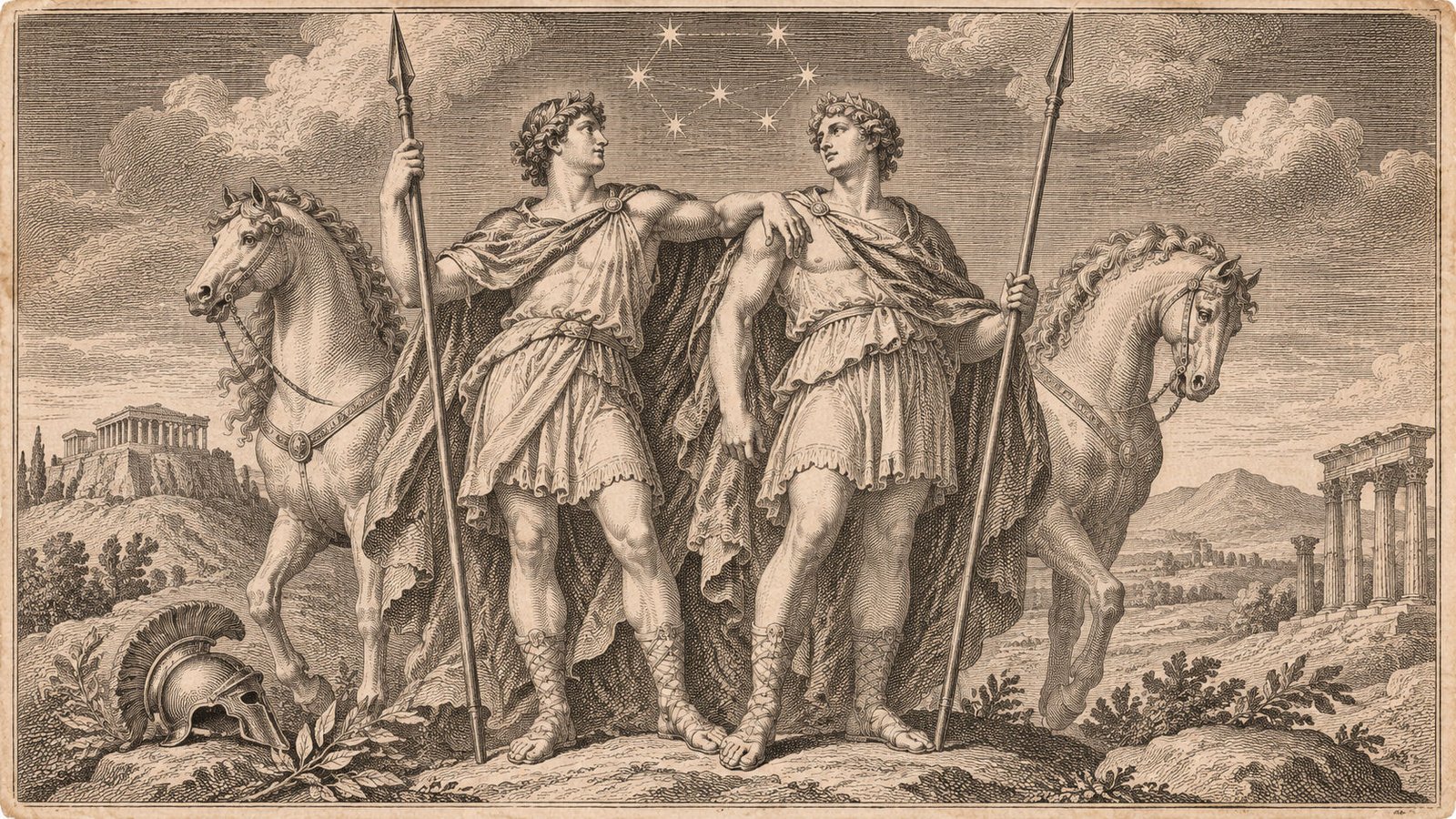
On the coins, we recognize them by their conical caps (pilos), above which there is usually one star. The stars indicate their divine nature and their connection with the sky. The Dioscuri also protected sailors: two luminous phenomena on the ship's sails during a storm were considered a sign of their help. Today, we know this phenomenon as the fire of Saint Elmo.
Why were the Dioscuri important to the Romans?
According to Roman tradition, Castor and Pollux appeared as mysterious horsemen in the battle near Lake Regillus in the early 5th century BC and helped the Romans defeat the Latins. Then they reportedly announced the victory at the Roman Forum, near the source of the nymph Juturna. A temple was erected there, traditionally dedicated in 484 BC.
Although it is a legend, it explains why the Dioscuri became the protectors of Roman cavalry and the symbol of the divine favor of the state. Their depiction on the banknote was not just a decoration: it reminded of military victory, courage, and the belief that the gods protected Rome.
Does our content help you?
Help others learn about numismatics and collecting for free. Your donation helps create new content and share knowledge.
By donating, you support the non-profit association NumizmatikaNET.
 Donate
Dioskuri on the earliest denarii
Around 211 BC, during the Second Punic War, Rome introduced the silver denarius. On its face was the head of the goddess Rome with the mark „X”, which denoted the value of ten bronze aces. On the obverse are two Dioscuri riding to the right, with spears and stars above their heads, and the inscription „ROMA”.
The motif thus linked the personification of the state with its mythical protectors. It also appeared on other early silver denominations, including quinaras and sesterces. Interestingly, even on earlier Roman quadrigats, around 225 BC, two joined heads appear. Some authors interpret them as Dioscuri, while others as the god Janus, so the identification is not in dispute.
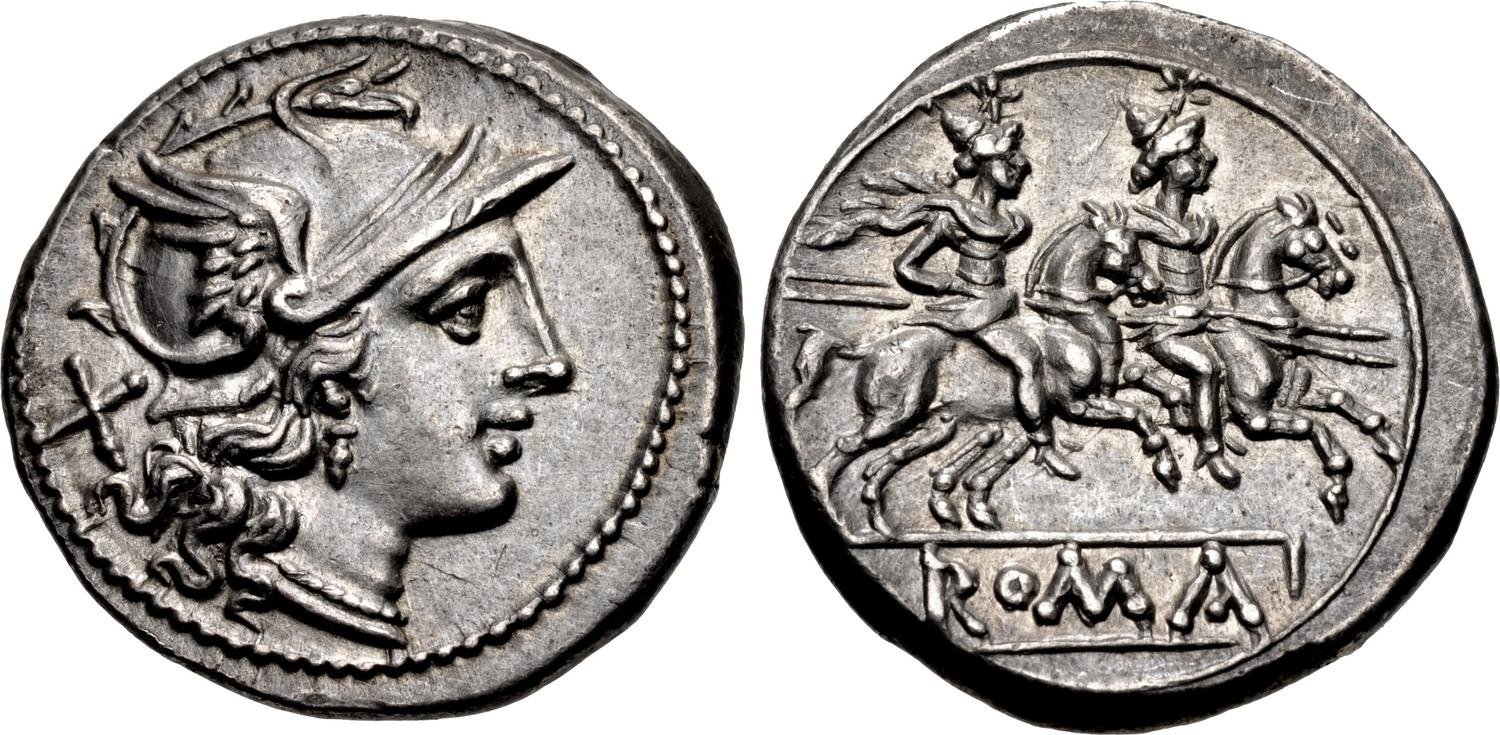
Specific example: Crawford 53/2 money
At the auction Classical Numismatic Group, Triton XXII, On January 8, 2019, under number 790, an anonymous silver denarius of the Roman Republic was sold, minted in Rome after the year 211 BC.
Lice: The head of Rome with a helmet, earrings and a necklace, turned to the right; behind the head is the value mark „X”.
Reverse: The Dioscuri on horses in gallop to the right, with spears, short coats, armor and helmets with stars; below the depiction is the inscription „ROMA” in a frame.
Characteristics: Silver; 4.15 g; 19.5 mm; mold position 3 h; XF preservation.
References: Crawford 53/2, Sydenham 311, RBW 193.
The coin has achieved 1.050 USD (approximately 916 EUR at the then current value), without the buyer's commission, at the initial price of 450 USD. This is not the value of any denarius with the Dioscuri, but applies to this particular example. The price is otherwise influenced by the type and variant of the coin, its preservation, its centralization, the quality of the mint and market demand.
A motif that survived the Republic
The Dioscuri were not limited to one type of Roman coin. In later Republican issues they also appear as standing youths or with their heads joined together. We also find them on the tetradrachms of the Greek-Bactrian king Eukratides I., and in the Roman Empire on some issues of Emperor Maxentius.
The two equestrian figures with the stars are therefore more than just an attractive ancient motif. On the small surface of the coin they combine the myth of fraternal love, the Roman tradition of victory, and the idea of divine protection of the state.
Edited: Zlatko Viščević with AI assistance
Images: Classical Numismatic Group (CNG), Triton XXII, lot 790; CNG.
Sources: Michael H. Crawford, Roman Republican Coinage (1974.); Ostia Antica; Forum Ancient Coins, Dioscuri; CNG, Triton XXII, lot 790.
Did you notice an error in the text or a linguistic inconsistency? Please report it to us via the page for Contact how we could fix it. Thanks in advance!
Was this article useful to you?
Help others learn about numismatics and collecting for free. Your donation helps create new content and share knowledge.
By donating, you support the non-profit association NumizmatikaNET.
Donate