Money coined in Split and for Split from the 12th to the 16th century can be divided into three basic groups: autonomous communal money (12th–14th century), the money of the city of Split coined for Count Hrvoje Vukčić Hrvatinić (1403–1413), and money coined in Venice for the needs of Split (1491–1518).
Autonomous communal money (12th–14th century)
The first group of Split coinage consists of a total of five different types of small dinars.
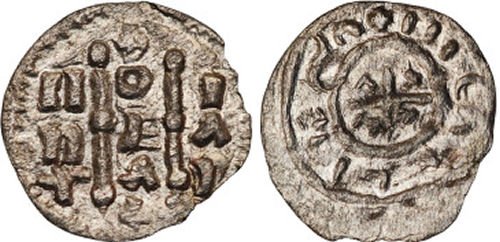
By first class dinars featuring a characteristic letter E on the obverse are considered, for which there is no reliable data regarding the exact beginning of their minting. Previous assumptions place this beginning in the period from 1105 (Ilkić, Filipčić); the reign of King Emeric, 1196–1204 (Arnold Luschin von Ebengreuth); and all the way to the mid-13th century (Dimnik, Dobrinić). (…)
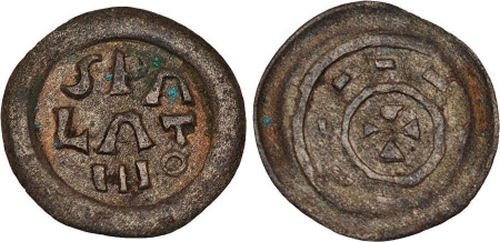
The Split mint is gradually replacing the first type of dinar – with another type, characterized by the Latin inscription of the city's name „SPALATINO“ or „SPALATINVS“. This obverse inscription is arranged in three lines within a (sometimes) beaded circle. This gives the coins a clear local identity and they lose the royal symbols, while continuity with the earlier type is preserved on the reverse, which retains the same cross motif as the first type of Split communal dinars. (…)
Forging of the second type, which can be placed in the period of the 13th century, shows a series of similarities in shape and reverse motifs with the first type, which leads to the conclusion that both types were in circulation simultaneously for a certain period of time.
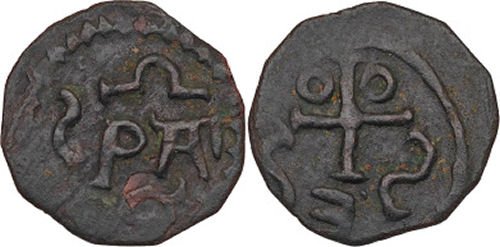
Third kind Split municipal dineras represent a kind of combination of the first and second types. On the obverse, there is an abbreviated inscription in the form of „SPA“ or „SPAL“, while in the lower part a decoration in the form of a reclining letter S is added. On the reverse, the letter E appears, in normal or inverted position, placed between two symmetrical letters S, and surmounted by a cross with one small circle in each of the upper corners.
This type clearly shows an iconographic connection with the first type (letter E and cross) and with the second type (name of the city), thereby representing a transitional phase in the typological evolution of the Split mint. Given the simplicity of execution and technical imperfection, the third type points to a later phase of minting. We place its emission at the beginning of the 14th century.
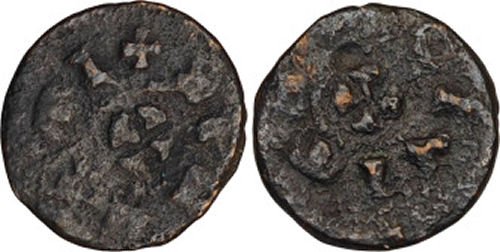
The Fourth Kind The Split dinar, known as a piccolo, is known in only a few specimens. On the obverse and reverse, there is a small cross with triangular arms, surrounded by an inscription; on the obverse „+ SPALATI“, and on the reverse „+ CIVITAS“.
With this type of coin, Split definitively departs from the Hungarian coin style and nominally and iconographically approaches the coins minted at that time by Venice and smaller Italian city-communes.
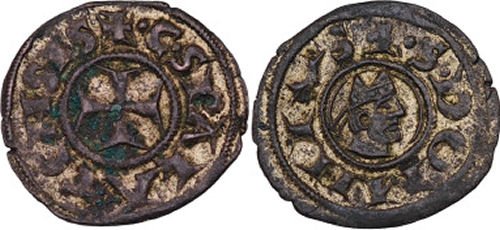
Fifth species Split's communal dinars represent a new phase of minting under the Venetian protectorate in the period from 1327 to 1357. The coins are made of a higher quality alloy compared to the third type, and are characterized by a significantly higher level of technical processing. The obverse depicts a concave flat cross within a circle, surrounded by the inscription „+ · C · SPALATENSIS“. On the reverse is the head of St. Domnius, the patron saint of Split, placed within a circle and surrounded by the inscription „+ · S · DOMNIVS“.
One specimen of this type kept in Osijek bears the inscription „+ · SPALETIO ·“ on the obverse, while the inscription on the reverse is identical to that on earlier types, namely „+ · S · DOMNIVS“. This fifth type is associated with a decree of the Venetian Senate from February 1354, which approved the free circulation of Split coinage adapted to the Venetian monetary system. This decree confirms that the people of Split, despite Venetian rule, retained the right to mint their own currency, which represents an exception in the practice of the Venetian Republic at that time.
Municipal money minted during the time of Duke Hrvoje Vukčić Hrvatinić (1403–1413).
At the beginning of the 15th century, the Split mint was reactivated under the patronage of Duke Hrvoje Vukčić Hrvatinić, who at the time held the title of Count of Split, Dalmatia, and Croatia, as well as Supreme Duke of Bosnia and Count of the Lower Regions. Hrvoje had silver groschen minted for the commune of Split and his own estates. These coins represented a novelty in the monetary system of Split because their value and standard significantly surpassed the previous small denominations. The groschen were slightly lighter than contemporary Venetian examples, but they were made of very high-purity silver.
The money of the city of Split minted for Duke Hrvoje Vukčić Hrvatinić in the period from 1403 to 1413 is divided into three basic denominations: groschen, denarii (half-groschen), and half-denarii (quarters of a groschen).
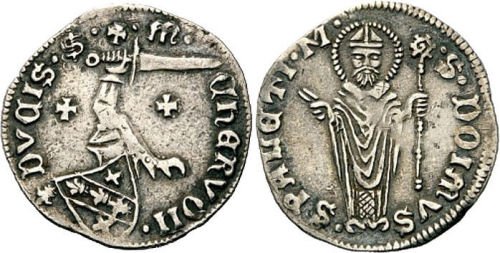
Groschen They are divided into two main sub-types. The first sub-type depicts on the obverse the family coat of arms of the duke with a slanted shield. On the shield, there is a horizontal fess with three fleurs-de-lis, while a cross is depicted in each of the upper right and lower left fields of the shield. Above the shield is a helmet from which an arm holding a sword emerges, and to the left and right of the arm is a small cross. The entire depiction is surrounded by an inscription. On the reverse is the figure of St. Domnius in episcopal vestments: his right hand is raised in a sign of blessing, while in his left he holds a crozier. His head is covered with a mitre and surrounded by a halo, and the entire depiction is surrounded by an inscription.
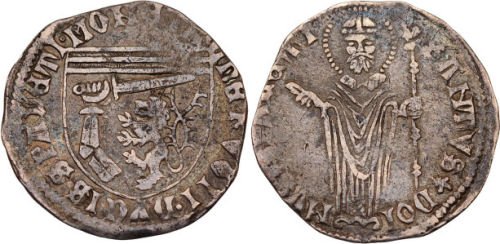
The second subtype of groschen shows on the obverse the ducal coat of arms composed of a large shield, in the upper part of which are two bars. Below them, on the left side, is a hand with a sword, and on the right, a rampant double-tailed lion. The entire depiction, as with the first subtype, is surrounded by an inscription. On the reverse is once again the figure of St. Domnius in episcopal robes, with his right hand raised in a sign of blessing and a crozier in his left hand, wearing a mitre on his head and a halo around it, with a corresponding inscription around the whole. There is also a type within this subtype of groschen where the mintmark R or A appears to the left of the saint's figure.
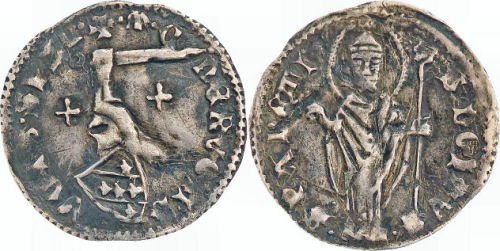
Dinari, namely half-groats, bear the family coat of arms of the duke with a slanted shield on the obverse. On the shield is a horizontal bar with three fleurs-de-lis, while the upper right and lower left fields of the shield each depict a cross. Above the shield is a helmet from which emerges an arm holding a sword, and to the left and right of the arm appear small crosses or fleurs-de-lis. The entire depiction is surrounded by an inscription. On the reverse is the figure of St. Domnius in episcopal attire; his right hand is raised in a gesture of blessing, while in his left he holds a crozier. His head is covered with a mitre and surrounded by a halo, and an inscription runs around the entire design.
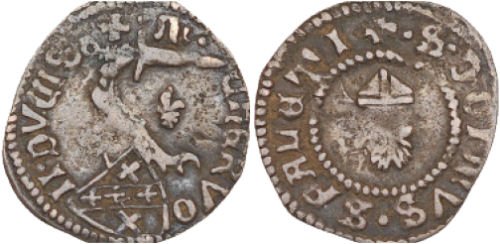
Poludinar, or a quarter of a groschen, also depicts the duke's family coat of arms with a slanted shield on the obverse. On the shield, there is a horizontal fess with three fleurs-de-lis, while the upper right and lower left fields are sometimes filled with small crosses and sometimes blank. Above the shield is a helmet out of which emerges an arm holding a sword, and to the right of the arm is a fleur-de-lis. The depiction, as with the other denominations, is surrounded by an inscription. On the reverse is the head of St. Doimus with a bishop's hat (mitre), surrounded by a circle of dots, along with the corresponding inscription.
The minting of these types of coins marks the peak of activity of the Split mint under Hrvoje Vukčić Hrvatinić, but at the same time its end, because after 1413 the mint ceased operations.
Money for the needs of Split minted in Venice (1491–1518)
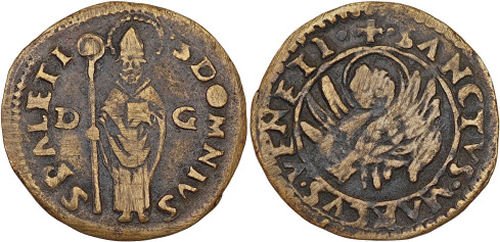
Following the fall of Split to Venetian rule in 1420, the city no longer had its own mint. However, the need for small circulation coins remained, so the Venetian Republic struck bagattini for Split with the inscription „· S · DOMNIVS · SPALETI ·“. These coins, representing the third group of Split coinage (VD#70–74), were minted in Venice based on Senate decrees from February 26, 1491, and 1497, as well as April 14, 1518. The obverse features, alongside the image of the saint, the initials of the Venetian mint masters: „ZF–M“ (Zuan Francesco Miani, 1491), „I–P“ (Jacopo Pizzamano, 1497–1498), and „D–G“ (Domenico Gritti, 1517–1518). The reverse depicts the head of the winged Venetian lion, surrounded by the inscription „+ · SANCTVS · MARCVS · VENETI ·“.
Although these bagattini retained a Split name, they are entirely Venetian products intended for local currency circulation in Split.
The text is taken from the book „The money of the city of Split“by authors Zlatko and Tomislav Dundović.
Authors: Zlatko Viščević I am Tomislav Dundović
Photos: Dean Duplančić, Robert Kavazović Horvat and Marko Šarinić
Source: „Money of the City of Split“, 1st Edition, 2026.